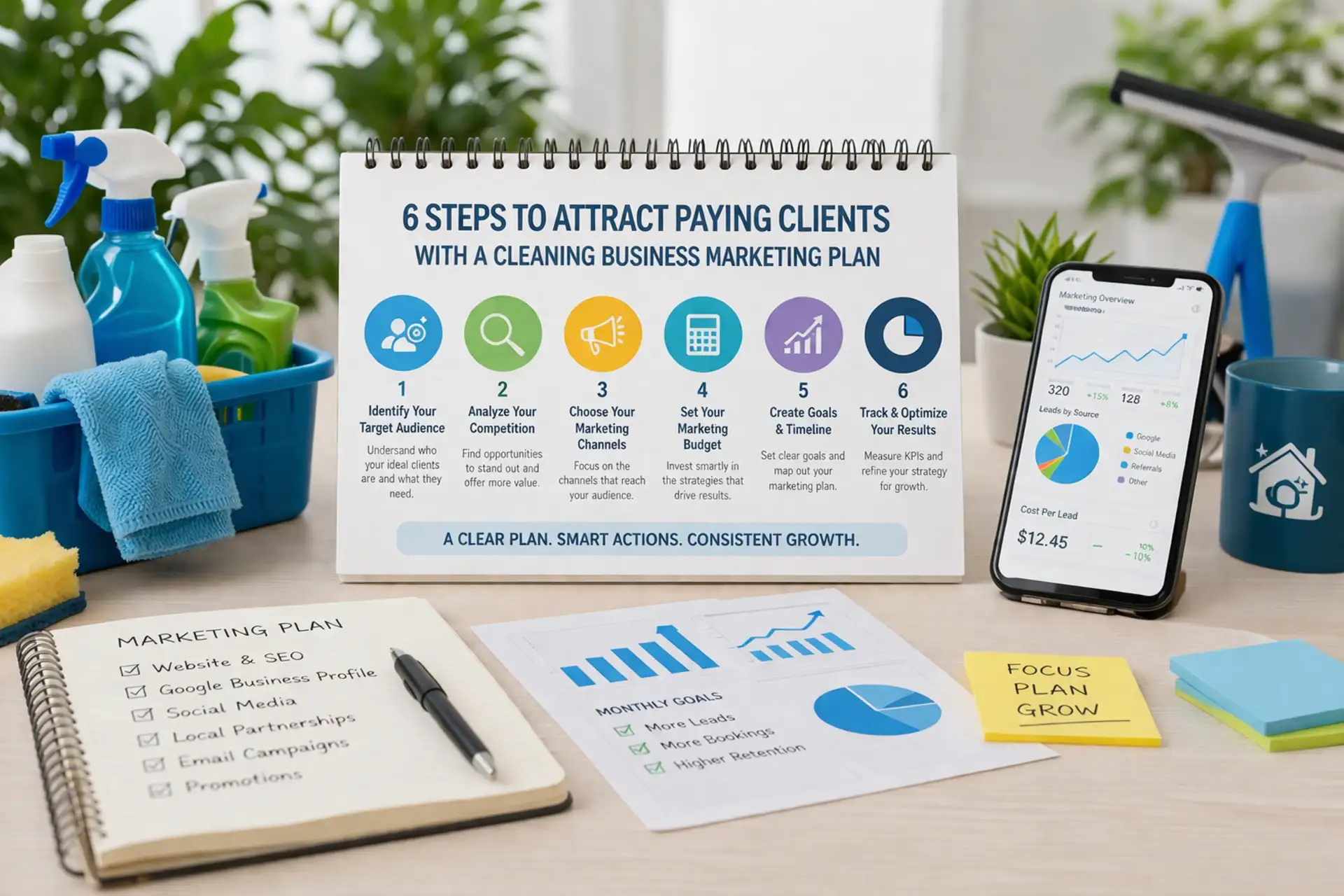
6 Steps to Attract Paying Clients with a Cleaning Business Marketing Plan
6 Steps to Attract Paying Clients with a Cleaning Business Marketing Plan
Many cleaning companies find it hard to get noticed, even with excellent staff, supplies, and customer service.
A strong marketing plan can close this gap by helping you reach new leads, stand out from competitors, and build a loyal customer base.
Below, you'll find six practical steps for creating an effective marketing plan for your cleaning business, plus a free template to help you start.
Key Takeaways
A clear marketing plan helps your cleaning business attract and retain loyal customers.
Analyzing competitors allows you to set your services apart and better understand customer needs.
Choosing the right marketing channels for your budget and goals is crucial for success.
Setting PACT goals (purposeful, actionable, continuous, trackable) and tracking KPIs will help you improve your marketing strategy over time.
What Is a Marketing Plan and Why Does Your Cleaning Business Need One?
A marketing plan is a written guide that details your entire marketing strategy—from identifying your target clients to selecting the best channels and outlining how you’ll attract and keep them. Here’s why a plan is essential:
Provides clear direction
Starting or expanding a cleaning business means handling many tasks, such as buying equipment, hiring staff, and organizing schedules. Without a plan, marketing efforts can become unfocused and less effective.
A marketing plan brings structure and focus. It tells you what steps to take, when to take them, and why—making sure every action supports your business goals.
Builds a foundation for long-term growth
Short-term tactics like ads or special offers can bring in clients, but lasting growth needs careful planning. A solid marketing plan helps you create ongoing strategies—like loyalty programs and seasonal campaigns—with a schedule to stay consistent.
It also lets you set clear goals and track key performance indicators (KPIs) to see what works and where to improve.
Boosts your credibility
A well-prepared marketing plan shows investors and lenders that you have a strategic, thoughtful approach. This can help you secure the resources to start or grow your cleaning business.
6 Essential Steps to Build a Marketing Plan for Your Cleaning Business
Step 1: Identify Your Ideal Customers
Even the best marketing plan will not succeed if it targets the wrong audience. Begin by clearly defining who you want to reach. This helps ensure your efforts are focused on the right channels, your messaging connects, and your pricing aligns with customer expectations.
Use these steps to identify your target customers:
1. Define Your Cleaning Services and Focus
Are your services designed for homes, offices, institutions, rental properties, or construction sites? Do you specialize in specific areas such as carpet, window, or post-renovation cleaning? The type of cleaning business you run and the services you offer will determine your ideal clients.
2. Identify the Key Decision-Makers
Who makes the decision to hire a cleaning service in your market? For residential cleaning, it’s usually the homeowner or tenant. For rentals or commercial properties, the property manager often decides. On construction sites, contractors are typically responsible for hiring.
3. Build customer personas using a KYC approach
After defining your general audience (such as homeowners), take the next step by visualizing your ideal customer in more detail. Are you focusing on working couples, larger families with kids and pets, or luxury property owners with both indoor and outdoor cleaning needs?
Create specific customer personas by outlining their needs, expectations, budgets, and challenges. A practical method for this is a KYC (know your customer) exercise:
Reach out to potential clients by phone or email to ask which cleaning services they require.
Review competitor feedback on platforms like Google or Yelp to understand what customers appreciate and where they see gaps.
Talk with peers in industry groups such as ISSA or the American House Cleaners Association to gather insights from their experiences.
Here’s a sample scenario of this process in action:
Airbnb hosts you contact mention that affordable pricing is their main concern.
However, competitor reviews show that Airbnb hosts are often willing to pay extra for quicker turnaround times.
Discussions with peers reveal that many Airbnb hosts want bundled services, including daily housekeeping for guests in addition to turnover cleaning.
Based on this, your customer persona might be an Airbnb owner who values speed and convenience, is open to higher costs for these benefits, and prefers bundled service options.
Step 2: Apply Porter’s Five Forces to analyze and outperform competitors
Promoting a cleaning business means showing customers what makes you unique. If you’re launching a new company or expanding into a new market, it can be challenging at first to determine which strengths to highlight.
Using the Porter’s Five Forces framework helps you assess the market, spot opportunities, and choose how to differentiate. This framework examines five key competitive forces that influence your industry and how profits are distributed among businesses, customers, and suppliers. By understanding these forces, you can identify where your business can excel and create a more effective marketing strategy.
Here’s how you can use the framework:
1. Existing competition
Who are your current competitors? (Tip: Try a quick Google search to find cleaning companies offering similar services nearby.) How do they present themselves (for example, as budget-friendly or eco-conscious), and what do customer reviews say on sites like Google or Yelp?
How this informs your marketing: Understanding competitor positioning lets you fine-tune your own messaging.
Example: If most local businesses focus on low prices, but reviews mention poor quality, you can promote your company as one that “never cuts corners.”
2. Threat of new entrants
How simple is it for new cleaning companies to start up in your market (considering startup costs, licensing, and regulations)? If barriers are low, new competitors can appear quickly, making pricing more competitive.
How this informs your marketing: If new entrants can easily attract your customers, focus on strengthening your brand, creating loyalty programs, or offering long-term discounts to keep clients coming back.
Example: Introduce a “Members” plan: priority scheduling, fixed rates for 6 months, and 20% off every fifth cleaning.
3. Customer power
Consider how many options customers have in your area, and whether they can easily negotiate lower prices or request more for the same cost—especially if switching providers is simple.
How it affects your marketing plan: When customers have greater influence, you’ll need to use clear service descriptions and emphasize value in your messaging.
Example: Specialized services, like post-construction cleaning, can set higher rates and highlight results instead of competing on price alone.
4. Supplier power
Think about your reliance on suppliers for materials, equipment, uniforms, and more. If you depend on just a few suppliers, changes in cost or availability can impact your profit margins.
How it affects your marketing plan: High supplier power can influence your pricing and service commitments.
Example: A carpet-cleaning company might use pet-friendly products, but if only one supplier provides them, it’s risky to base all marketing on that feature.
5. Threat from substitutes
Ask what alternatives exist to your cleaning services. Could customers handle tasks themselves, use automated tools like robot vacuums, or hire freelancers through apps?
How it affects your marketing plan: This determines how you communicate your service’s unique value and why it’s not easily replaced.
Example: For home cleaning, emphasize deep cleaning, bathroom scrubbing, and event cleanups—tasks that are difficult for customers or robots to manage well.
Step 3: Choose a variety of marketing channels
There are many effective ways to connect with cleaning customers, both online and offline. Consider these common marketing channels:
Business website. The most effective cleaning company websites are straightforward yet informative, providing pricing, service details, job photos, customer testimonials, contact information, and a booking form. Be sure to use local keywords (such as “window cleaning in Portland”) to help customers find you quickly.
Professional profiles. Create and maintain a Google Business Profile and Yelp listing, including your services, contact details, business hours, and customer reviews. These profiles increase your visibility and reinforce your business’s credibility.
Social media. Share before-and-after images, behind-the-scenes updates, customer feedback, and even ASMR cleaning vide os on platforms like Instagram, TikTok, and Facebook.
Paid ads. Platforms such as Google Ads and Meta Ads allow you to target people in your local area who are searching for cleaning services.
Television and print advertising (such as local newspaper ads) are options, but they tend to be costly for new or smaller cleaning businesses.
Direct outreach and email campaigns. Stay top of mind by sending newsletters, special offers, or quick follow-ups. You can find potential clients using LinkedIn, Google, social media, or platforms like RocketReach that provide verified contact details.
Physical marketing. Distribute cleaning flyers in local communities, place door hangers in apartments and offices, or send brochures and coupons through direct mail.
Partnerships. Build relationships with property managers, realtors, contractors, or others in related industries who can use or recommend your cleaning services.
This Might Interest You
To see which marketing channels real cleaning professionals use, explore this recent Reddit discussion. Some prefer cold calling and handing out flyers, while others focus on having a modern, reliable website.
You don’t need to use every channel. In fact, it’s best to start with one or two that match your business. For example, if you mainly serve local neighborhoods, focus on physical marketing and partnerships first. Once these methods are effective, you can gradually add more channels.
Step 4: Plan and allocate your marketing budget
After selecting your marketing channels, determine how much you can invest in each. Many cleaning businesses dedicate 7–10% of their yearly revenue to marketing. If you’re new and haven’t generated revenue yet, apply this percentage to your startup budget instead.
For instance, if your cleaning business earns $100,000 annually, you should set aside $7,000–$10,000 for marketing. If you’re launching with $20,000 in startup funds, plan to use about $1,400–$2,000 for marketing activities.
The way you divide your marketing budget should reflect your specific niche, target customers, and business goals. For example:
A solo home cleaner starting out might focus more on printed flyers or door hangers, as these are more affordable than online advertising.
A window cleaning business may prioritize building relationships with property managers, since they regularly need window cleaning services.
A short-term rental cleaning company could invest in targeted ads featuring its services, before-and-after photos, and client testimonials to quickly attract new clients.
Next, create a straightforward budget table that lists each marketing channel alongside your planned spending. (You can view an example in the marketing plan template.) Add two columns to track actual expenses and monitor your remaining budget.
Step 5: Set PACT goals and create your marketing timeline
While many companies use SMART goals (specific, measurable, achievable, relevant, and time-bound), such as “gain 10 new home cleaning clients within 3 months,” PACT goals often work better for cleaning businesses. PACT goals focus on ongoing learning and continuous improvement, rather than aiming for a single target.
PACT stands for:
Purposeful: Tied to a meaningful outcome, not just numbers—for instance, building loyal customers or strengthening your local reputation.
Actionable: Broken down into clear, manageable steps.
Continuous: Reviewed and updated regularly, rather than set once and forgotten.
Trackable: Measured using KPIs (key performance indicators) like website visits, conversion rates, or customer acquisition costs.
For example, a PACT goal could be: “Increase local visibility this year by testing different strategies to reach nearby customers.”
Once you have your goal, break it into specific tasks and add them to a marketing calendar or Gantt-style timeline with deadlines to keep your efforts organized.
Did You Know?
Industry experts agree that using a calendar is essential. Many successful cleaning businesses plan their marketing activities throughout the entire year to stay consistent and take advantage of seasonal opportunities. For example, some companies promote gift certificates around Mother’s Day and Christmas, focus on attracting new recurring clients in spring and fall, and offer discounts during slower summer periods.
Based on this approach, your schedule could look like this:
Q1: Set up your Google Business Profile and improve local SEO.
Q2: Add a “How did you hear about us?” question to your client booking forms.
Q3: Distribute cleaning flyers across targeted neighborhoods in the week before Halloween.
Q4: Review your Google and local map rankings, and measure how many leads came from flyers.
TARGPatrol can help simplify this process. You can use customizable digital forms to add a “How did you hear about us?” field to booking or feedback forms, while task tracking features make it easier to assign marketing activities, send reminders, and monitor progress in one place.
Step 6: Monitor Your Marketing KPIs
Tracking key performance indicators (KPIs) helps you see which marketing strategies are working and where improvements are needed.
Key KPIs to track include:
Website traffic: The number of visitors who take actions such as requesting a quote or booking a service.
Google Business calls and reviews: How often customers reach out via Google and the feedback they leave about your service.
Referral numbers: The number of clients gained through word-of-mouth or partner referrals.
Cost per customer: The total spent to attract and convert each new client.
Conversion rate: The percentage of inquiries that turn into paying customers.
Repeat customer rate: The percentage of customers who return for additional services.
Review your KPIs at the end of each quarter: March 31 (Q1), June 30 (Q2), September 30 (Q3), and December 31 (Q4). This regular review helps you test strategies, measure outcomes, and adjust your marketing plan as needed.
Use Mobile Apps to Track Operations, Team Productivity, and Profit
A marketing plan helps bring in new clients, but long-term success also depends on how efficiently you run your cleaning business after winning the work. This is where mobile apps can make a major difference.
For cleaning companies, a mobile app is more than a scheduling tool. It can help you track day-to-day operations, monitor employee activity, and measure the numbers that affect profitability.
With the right system, you can:
track completed tasks and missed steps in real time
monitor check-ins at client sites
collect photos, comments, and service proof from the field
reduce paperwork and manual follow-up
improve team accountability and response times
generate reports on performance across locations, teams, and contracts
This data helps you understand whether jobs are being completed as planned, whether teams are productive, and whether certain clients, locations, or services are actually profitable.
For example, if a contract looks profitable on paper but requires frequent extra visits, repeated corrections, or too much travel time between sites, a mobile app can help you spot that early. You can then adjust staffing, routes, pricing, or service scope before the problem affects your margins.
Tools like TARGPatrol help cleaning businesses digitize field operations by giving managers visibility into tasks, check-ins, issues, time spent on site, and team movement. This makes it easier to track KPIs, standardize service delivery, and improve operational control across all locations.
In other words, marketing gets clients in the door, but operational visibility helps you keep those clients profitably.
KPIs You Can Track With a Mobile App
A mobile app can help cleaning businesses monitor important operational and financial KPIs, such as:
task completion rate
missed or late visits
average time spent per location
issue frequency by site
repeat service problems
employee productivity
travel time between jobs
contract performance by location
labor hours vs. revenue
When you combine your marketing plan with better operational tracking, you create a stronger foundation for growth.
Connect Marketing Results to Real Profit Using a Mobile App
Creating a marketing plan helps bring new customers to your cleaning business. But to understand whether your marketing efforts are truly working, you also need to track what happens after a client signs up.
This is where many cleaning companies struggle. They may know how many leads came from Google, flyers, or referrals, but they don’t always know which channels bring the most profitable clients.
By combining your marketing strategy with operational data from a mobile app, you can connect the full picture—from lead generation to actual service delivery and profit.
For example, if you include a simple question such as “How did you hear about us?” in your booking or inquiry forms, you can identify where each new client came from. Then, using operational tracking tools, you can monitor how those clients perform over time.
With a platform like TARGPatrol, you can track:
time spent on each job
number of visits required
issues reported at the location
labor hours per client
task completion performance
operational costs related to the service
When you combine this information with your marketing data, you gain valuable insights.
For instance:
A client acquired through Google Ads may generate many bookings but require frequent extra visits or corrections.
A client acquired through a property manager partnership might require fewer resources and produce higher long-term revenue.
Without operational tracking, both customers appear equally valuable. With proper data, you can clearly see which marketing channels generate the most profitable work, not just the most leads.
Example: Linking Marketing and Operational KPIs
By integrating marketing and operational data, cleaning businesses can track metrics such as:
Customer acquisition cost (CAC) by marketing channel
Average revenue per client
Labor hours per contract
Service frequency and repeat visits
Profitability by location or client type
This helps you answer important questions like:
Which marketing channels bring the best long-term clients?
Which services generate the highest margins?
Which contracts require too much time or travel?
Where should you invest more marketing budget?
Why This Matters for Growth
Marketing alone brings opportunities, but operational visibility turns those opportunities into profit.
When your marketing plan is connected with operational tracking tools like TARGPatrol, you gain a much clearer understanding of your business performance. Instead of guessing which campaigns work, you can make decisions based on real data—from the first customer inquiry to the final completed job.
This allows cleaning business owners to optimize both their marketing spend and their operational efficiency, creating a more sustainable and profitable business.
FAQs
What are some common mistakes in cleaning marketing?
Common mistakes in cleaning marketing include relying too much on word of mouth, overlooking customer reviews on platforms like Google or Yelp, and failing to track the return on investment (ROI) of your marketing activities.
What type of cleaning makes the most money?
Commercial cleaning—especially for large spaces such as schools, malls, and office buildings—tends to be the most profitable cleaning business because it involves regular, frequent service. Post-construction cleaning, biohazard cleanup, and pressure washing can also be highly profitable due to their specialized skills and equipment requirements.
How can you start a cleaning business?
Begin by choosing your cleaning niche: residential, commercial cleaning, or specialty services. Next, register your business, obtain necessary licenses and insurance, purchase essential cleaning supplies, and hire staff. Finally, promote your services to attract your first clients.
How do I get cleaning clients fast?
To quickly gain cleaning clients, ask previous contacts for referrals, offer limited-time promotions, and post in local Facebook or Nextdoor groups. Claim and optimize your Google Business Profile and request reviews from every new customer. Respond promptly to inquiries and make booking simple with text and online forms.
How much should I charge to clean a house?
Set your rates based on the local market, home size, condition, and type of service. Many cleaners charge per hour or offer a flat rate per job. Estimate labor time, add supply costs, overhead, and profit, then compare your pricing to local competitors and adjust as needed.
Disclaimer
This article is intended solely for general information and education. It does not offer business, financial, or professional advice, and should not be used as a substitute for such advice. The TARGPatrol team is not responsible for any actions taken or not taken based on the information provided in this article.