5 Key Factors That Make a Cleaning Business More Profitable
Thinking about starting a cleaning business? One of the first questions you’ll probably ask is whether it can be profitable.
The answer is yes. A cleaning business can generate strong income, but profitability depends on several factors. Your results will largely be shaped by your business model, pricing approach, operating costs, and how efficiently you run day-to-day operations.
In this guide, we’ll look at what healthy profit margins can look like for a new cleaning business, how to measure your earnings, and which factors have the biggest impact on long-term profitability.
Key takeaways
Solo cleaning businesses often achieve the highest profit margins, usually around 30% to 45%, while companies with employees more commonly operate in the 15% to 25% range.
Specialized services such as carpet cleaning and post-construction cleaning can support higher pricing and often deliver margins above 40%.
Clear pricing, recurring contracts, and strong cost control are some of the most effective ways to improve profitability.
Cleaning Business Profit Margins: How Much Can a Company Earn?
When discussing cleaning business profitability, the most important metric is net profit margin. This is the percentage of your revenue that remains after all business expenses have been paid.
For example, imagine you charge a client $500 for a deep cleaning service. The breakdown might look like this:
Category | Description | Amount |
|---|---|---|
Revenue | Total amount billed to the client | $600 |
Direct costs | Wages, supplies, and materials used for the job | -$240 |
Overhead | Insurance, fuel, software, advertising, and admin costs | -$150 |
Total expenses | -$390 | |
Net profit | Amount left after expenses |
In this case, your net profit margin would be:
$210 ÷ $600 = 35%
So, for every $600 job with this type of cost structure, your business keeps $210 as profit.
If you want, I can also make it sound more SEO-friendly or more natural for a blog article.
What Are Realistic Net Profit Margins for a Cleaning Business?
Net profit margins in the cleaning industry can vary widely because not all businesses operate in the same way. Your margins will depend on the type of services you offer, your pricing, labor structure, overhead, and overall efficiency.
Based on common industry patterns, here are some realistic net profit margin ranges for different cleaning business models:
Business Model | Typical Net Profit Margin | Why It Varies |
|---|---|---|
Solo operator | 25%–40% | Owner-operators often keep higher margins because they handle the work themselves and have lower labor costs. |
Small team (2–4 crews) | 12%–22% | Hiring staff increases capacity, but wages, supervision, and scheduling costs reduce margins. |
Commercial cleaning | 8%–20% | Commercial contracts can provide stable income, but competitive pricing often puts pressure on margins |
Franchise business | 8%–14% | Franchise fees, royalties, and operating requirements usually reduce take-home profit. |
Specialty cleaning services | 30%–50% | Services like carpet cleaning, floor care, and post-construction cleanup often support higher prices and stronger margins. |
As this table shows, there is no single standard profit margin for every cleaning business. Profitability is closely linked to your business model and how efficiently you manage operations.
These ranges are useful as general benchmarks, but they are still only averages. The best way to understand your true profitability is to track your own revenue, labor costs, overhead, and job performance consistently.
For cleaning businesses working in hospitality, service quality and consistency have an even bigger impact on profitability. Hotels and premium properties often expect detailed processes, fast response times, and high presentation standards. If your company serves this segment, it helps to understand what top-tier clients look for. You can read more in our guide to Forbes 5-Star hotel standards.
How to Track Your Cleaning Company’s Profits
To understand how profitable your cleaning business really is, you need a clear view of both your income and your expenses. The goal is to know not just how much money is coming in, but exactly where it is being spent each month.
Start With a Monthly Profit and Loss Statement
One of the most useful tools for tracking profitability is a profit and loss (P&L) statement. In simple terms, this is a monthly summary that shows your revenue, expenses, and net profit.
A P&L statement helps you measure how your business is performing over time and makes it easier to spot problems early, such as rising labor costs, overspending on supplies, or low-margin jobs.
A practical way to organize your numbers is to divide expenses into two main categories:
Direct costs — expenses tied directly to delivering the service, such as employee wages, contractor payments, and cleaning supplies
Overhead — ongoing business expenses such as insurance, software, fuel, marketing, office costs, and admin expenses
When you separate costs this way, it becomes much easier to see how much each job contributes to profit and where your business may be losing money.
Your monthly breakdown might look something like this:
Category | Amount |
Revenue | $24,500 |
Home cleaning | $14,000 |
Office cleaning | $7,500 |
Deep cleaning | $3,000 |
Direct costs | $9,800 |
Labor | $8,900 |
Supplies | $900 |
Overhead | $6,200 |
Owner pay | $3,500 |
Transport | $700 |
Insurance | $500 |
Marketing | $750 |
Software | $150 |
Equipment | $250 |
Other expenses | $350 |
Net profit | $8,500 |
Profit margin | 35% |
A profit and loss statement gives you a much clearer view of your business finances. It shows not only your profit margin, but also where your income comes from and where your money is going.
With that information, it becomes easier to make practical decisions, such as when you can invest in new equipment or whether your marketing spending is actually paying off.
It’s a good idea to review your P&L every month so you can spot issues early and take action before small problems become bigger ones.
Track the Numbers That Matter
A monthly profit and loss statement is a strong starting point, but it should not be the only thing you monitor. To understand profitability more deeply, it helps to track a few additional metrics that can guide better business decisions.
Profit by service type
Not every service delivers the same margin. A standard house cleaning job and a carpet cleaning job may bring in the same revenue but produce very different profits. When you track profit by service category, you can identify which services are worth promoting more aggressively.
Customer lifetime value (LTV)
This shows how much revenue a typical customer generates over the full length of the relationship. Knowing this number helps you understand the long-term value of repeat clients and gives you a clearer idea of how much you can reasonably spend to win a new customer.
Customer acquisition cost (CAC)
To calculate this, divide your monthly marketing spend by the number of new customers you gained during that period. This tells you how much it costs, on average, to acquire one new client. When compared with lifetime value, it becomes a useful way to measure whether your marketing is efficient.
Labor cost percentage
Labor is often the biggest expense in a cleaning business, so it is important to track it closely. Measure total labor costs as a percentage of revenue to see whether staffing levels and pricing still make sense. If labor takes up too much of your income, it may be a sign that you need to improve efficiency, raise rates, or adjust the type of work you take on.
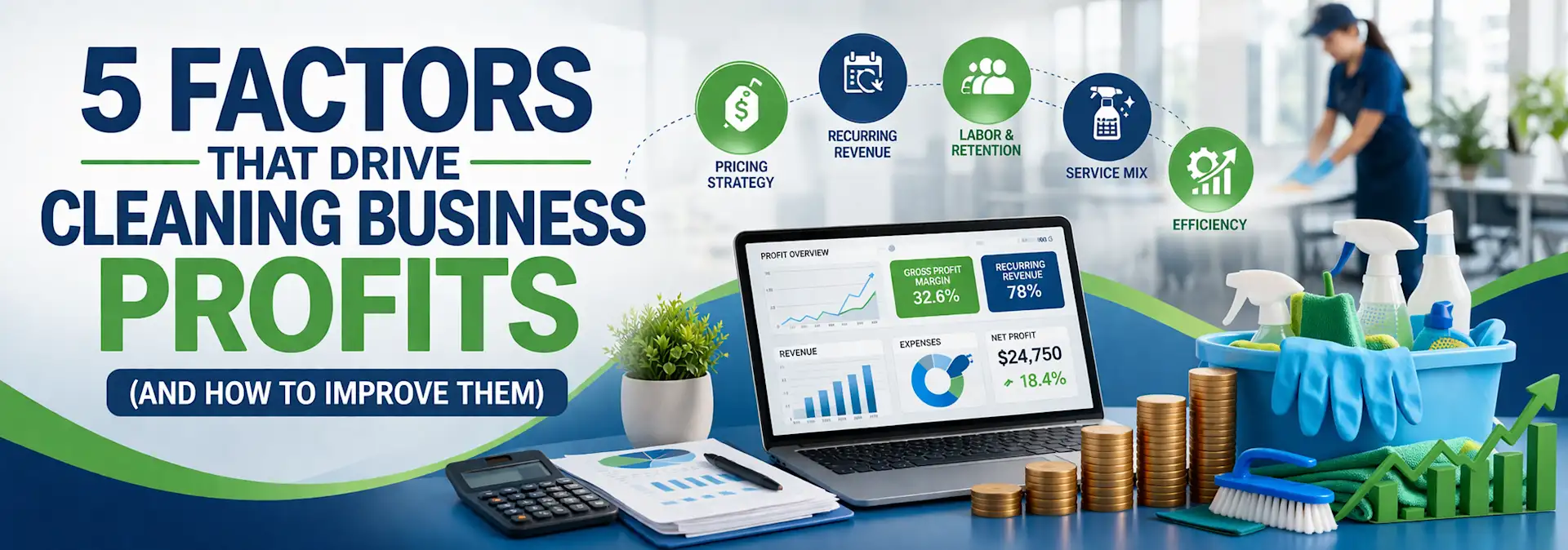
5 Factors That Affect Cleaning Business Profitability and How to Improve Them
Now let’s look at the main factors that have the biggest impact on cleaning business profit margins and what you can do to improve them.
1. Pricing Strategy
Pricing is one of the most important drivers of profitability. Many cleaning companies lower their prices to win more business, but this often leads to tight margins and unprofitable contracts. Low pricing may help secure work in the short term, but it can quickly hurt the business once labor, supplies, travel, and overhead are taken into account.
The most profitable companies usually do not compete by being the cheapest option. Instead, they focus on the value they provide, such as reliability, better service quality, healthier environments, and less stress for the client.
A stronger approach is to calculate your real costs for each job and then add a healthy margin on top. In many cases, aiming for a margin of around 20% to 30% can create a more sustainable pricing structure. If your schedule is consistently full and you are regularly turning down work, that may also be a sign that your prices are too low.
The goal is not simply to win more contracts. It is to win contracts that are worth doing and that contribute to long-term profit.
2. Recurring Revenue vs. One-Time Jobs
One-time cleaning jobs can bring in revenue, but they also require constant effort to find new customers. Recurring contracts create more stable and predictable income, which makes it easier to plan staffing, manage cash flow, and grow the business.
For that reason, many cleaning companies focus on building long-term client relationships through services such as weekly office cleaning, routine facility maintenance, or bi-weekly residential cleaning.
A smart strategy is to treat one-time jobs as an entry point. After completing the initial service, offer the client an ongoing maintenance plan. You can also encourage repeat bookings by creating recurring service packages with a small discount. In many cases, the long-term value of a repeat customer is far greater than the profit from a single job.
3. Labor Costs and Employee Turnover
Labor is one of the biggest expenses in any cleaning business, and high employee turnover can make it even more costly. When workers leave frequently, you spend more time and money on hiring, training, and fixing service issues caused by inexperience or understaffing.
That is why it is important to focus not only on wages, but also on retention. Offering competitive pay, clear onboarding, and well-documented processes can help reduce turnover and improve consistency. It also helps to show employees that there is room to grow, whether into senior roles, team leadership, or management positions.
You should also monitor labor costs closely by service type or job. If labor regularly takes up too large a share of revenue, it may be a sign that pricing needs to be adjusted or that your workflow needs to become more efficient. Keeping labor under control without sacrificing quality is a key part of protecting your profit margins.
4. Your Service Mix
The types of services you offer can have a major impact on profitability. Standard house cleaning is often highly competitive, which can make it harder to maintain strong margins. Specialized services, however, usually allow for higher pricing and better returns.
Services such as carpet cleaning, post-construction cleaning, move-out cleaning, short-term rental turnovers, floor care, or window cleaning can often generate more profit than general cleaning alone. Adding the right services can also increase revenue from existing clients without increasing your marketing costs.
A good approach is to choose specialty services that fit your target market. Residential clients may need deep cleans or move-in and move-out services, while commercial clients may be more interested in floor maintenance or sanitization. By tracking profit by service type, you can see which offerings perform best and focus more of your sales and marketing efforts on the most profitable ones.
5. Efficiency and Waste
Small inefficiencies can reduce profit faster than many business owners realize. Extra travel time, missed steps, poor scheduling, and inconsistent processes may seem minor on their own, but over time they can significantly affect margins.
Improving efficiency starts with better systems. Create clear checklists and standard procedures for each service so employees can work more consistently and new team members can get up to speed faster. This helps reduce mistakes, maintain service quality, and save time on every job.
It is also useful to track time and job activity more accurately. Knowing when employees start work, how long jobs take, and how teams move between locations can help you identify wasted time and improve planning.
Scheduling also plays a big role. Grouping jobs by area, reducing unnecessary travel, and building more efficient daily routes can increase the number of jobs completed without adding more labor hours.
In many cleaning businesses, better organization and less wasted time can have a direct and measurable impact on profitability.