Forbes 5-Star Hotel Standards — How to Run Them Efficiently in 2026

Forbes 5-Star Hotel Standards — How to Run Them Efficiently in 2026
A Forbes Travel Guide (FTG) Five-Star rating isn’t a “luxury vibe” award. It’s a verification system: anonymous, on-site inspections against an extensive set of criteria—where service execution carries the most weight. The point is simple: Five Stars are earned through repeatable consistency, not a one-time renovation or a “Forbes month” preparation sprint.
That creates a practical management challenge for hotels: you can have beautifully written SOPs and still fail a Forbes-style inspection because the real gaps happen between documents—missed micro-checks, inconsistent proof, delayed fixes, and feedback loops that surface issues only after the shift is over.
This article breaks down what “Forbes 5-Star standards” mean in 2026—and shows how to operationalize them with mobile workflows, so standards become a daily, shift-by-shift system built on evidence, accountability, and performance analytics.
What “Forbes standards” are (and aren’t)
What they are ✅
A guest-journey evaluation system covering the full experience: pre-arrival → arrival → in-stay touchpoints → problem resolution → departure.
A measurable inspection methodology performed by incognito inspectors, not announced audits.
Service-led scoring: directionally, service execution dominates over facilities; the operation must be excellent, not just impressive.
What they aren’t ❌
Not a design contest. Facilities matter, but they rarely save inconsistent service.
Not a one-time project. A Five-Star operation behaves the same on Tuesday at 2 p.m. as on Saturday at 8 p.m.
Forbes 5 Star Standards in 2026
Across FTG’s public positioning and how hotels interpret it in practice, the Five-Star outcome usually requires four conditions to be consistently true:
Service is proactive (guests don’t have to ask twice; staff “own” requests end-to-end).
Personalization is real (preferences are captured and actually executed across departments).
Consistency beats occasional brilliance (baseline excellence matters more than rare hero moments).
Quality control is visible in micro-details (spotless, repeatable cleanliness; the physical product matches the promise).
In 2026, that’s harder than it sounds because of expectation inflation, labor volatility, and operational complexity across channels (chat/apps/messengers) that increase the risk of dropped requests and uneven execution.

Manage Forbes standards by guest journey
If you want Five-Star performance, manage the operation in journey segments—because that’s how guests experience the hotel, and how weak links become obvious.
📩 Pre-arrival (“confidence” phase)
Controls: response-time SLAs, confirmation accuracy, proactive outreach for high-friction arrivals.
Failure modes: slow replies, vague confirmations, preferences captured but not activated.
🛎️Arrival & check-in (“first proof” phase)
Controls: recognition, luggage handling consistency, queue avoidance, room readiness discipline.
Failure modes: inconsistent welcome, poor orchestration at peaks.
🧼In-room experience (“truth serum”)
Controls: housekeeping detail standards, engineering readiness, amenity completeness.
Failure modes: micro-defects (smudges, hair, dust lines), slow fixes without closure.
🍽️Service touchpoints (F&B, spa, concierge, turndown)
Controls: service choreography, knowledge confidence, recovery protocols.
Failure modes: uneven service across outlets, no follow-up after fulfillment.
🧯Problem resolution (where stars are won/lost)
Controls: first-contact resolution, time-to-acknowledge/fix, empowerment, documentation to prevent repeats.
Failure modes: guest repeats issue to multiple people, “fixed” without ownership/closure loop.
✈️Departure & post-stay (“memory lock”)
Controls: billing accuracy/speed, transport coordination, meaningful follow-up.
Failure modes: a great stay undermined by folio disputes or slow checkout.
The real bottleneck: standards on paper don’t survive real shifts
Quality—steady, reliable, consistent—isn’t achieved with a single inspection and a memo. It’s a repeatable, managed routine that runs every shift. When that routine lives on paper and scattered spreadsheets, it breaks:
photos and comments get stuck in chats,
GPS/timestamps aren’t captured,
deadlines slip,
managers learn about issues after the window to act has closed.
Why paper falls short (especially for Five-Star)
No verifiable evidence: without photos/video, GPS, timestamps, audit trail, checks are easy to fudge.
Slow, reactive cycle: consolidation takes days; by then the chance to fix is gone.
Weak analytics: disconnected files don’t reveal trends or root causes—so problems repeat.
What a Forbes-ready management system looks like
To make standards real, you need a management loop that runs continuously:
Standards are explicit (not tribal knowledge)
Execution is checked (walkthroughs, spot checks)
Evidence is captured (photos, comments, timestamps, accountability)
Gaps become tasks (owners + deadlines)
Progress is visible (dashboards, repeat issues, completion rates)
Training closes the loop (coaching linked to observed failures)
If you can’t prove it happened, you’re relying on hope—and hope doesn’t earn Five Stars.
TARGPatrol: How to Manage and Automate Forbes Standards
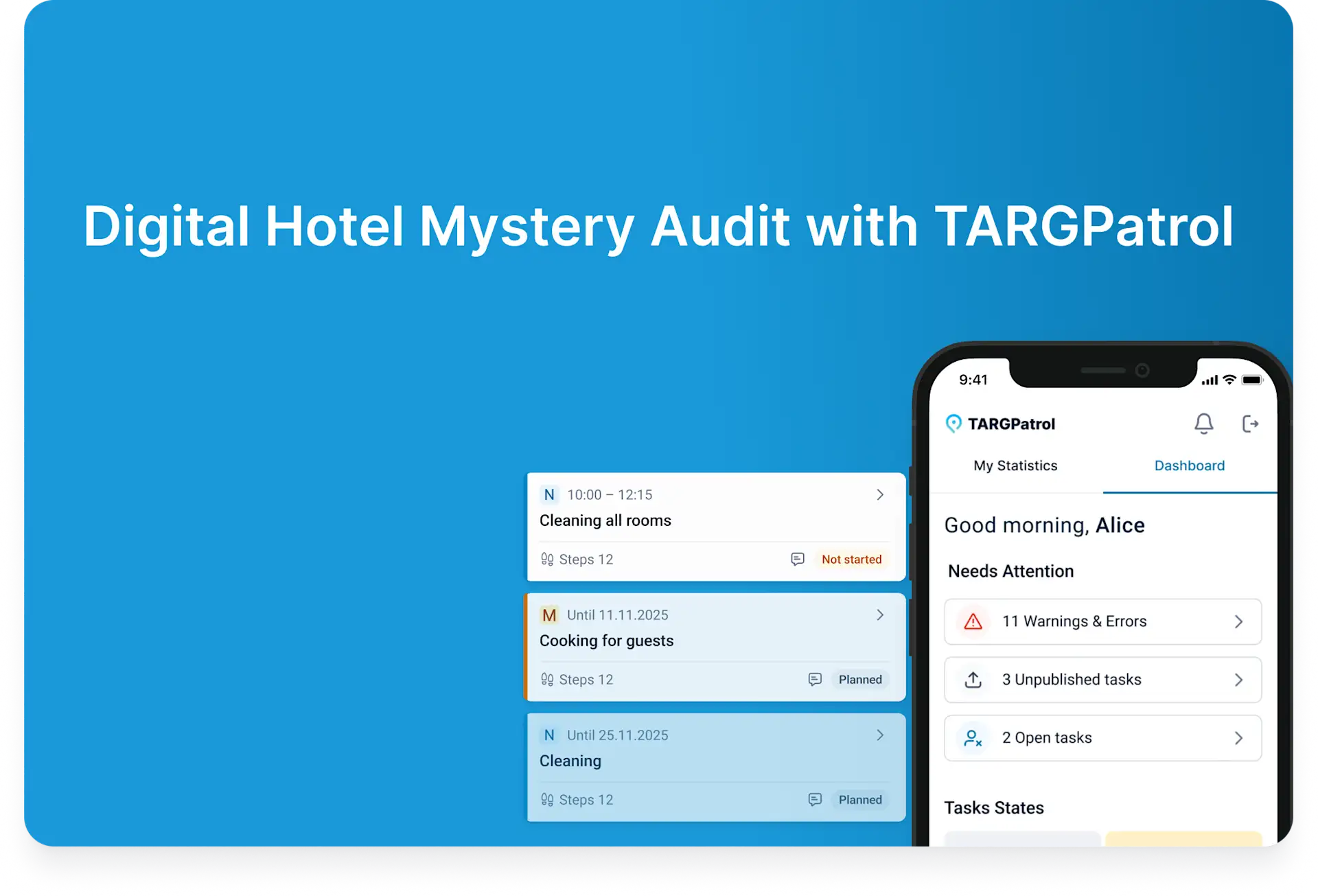
TARGPatrol exists to turn checklists into executable workflows. Every item becomes a clear task on a phone with who, where, when, and proof; any deviation instantly creates a corrective task with an owner, deadline, and “after” evidence.

The core execution model (what changes operationally)
You stop managing standards as “documentation” and start managing them as a closed-loop operating system:
Prevent: standards are executed on schedule, with proof rules
Detect: deviations are captured on the spot with evidence
Correct: failures create tasks with SLAs and reminders
Verify: closure requires “after” proof (photo/re-measurement)
Improve: dashboards reveal repeat issues, weak zones, and training needs
This is exactly the posture a Forbes-level operation needs: fast feedback + hard evidence + accountability.
The features that matter for hotels
📷 Evidence-based proof per item
Photo/video proof per item
Optional live-shot only (no gallery uploads)
Great for rooms, public areas, BOH, engineering checks
📍 Time & location control
GPS/geofence + timestamps
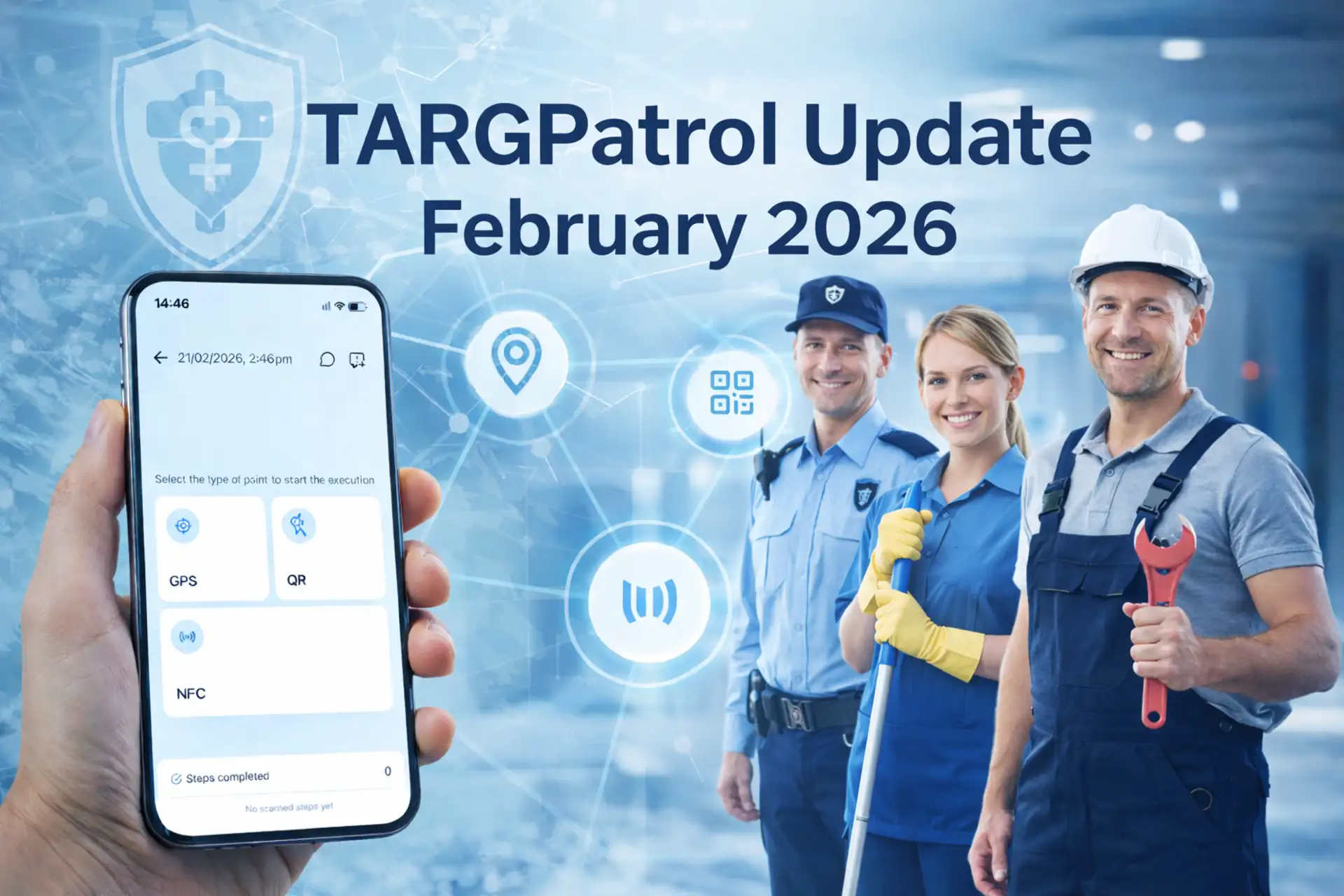
QR/NFC tags for point confirmation (exact pantry/service room/exit)

🔔 Auto-escalation
Fail → corrective task (owner + SLA + reminders)
Closure requires “after” proof
🌐 Offline-first
Works in basements/service corridors
Syncs safely later
📊 Live manager dashboard
Live status, overdues, recurring issues, coverage by zones/sites
🔌 Integrations & export
Excel/BI export + open API
Fits your ERP/quality stack
Checklists for Hotel Operations and Workflows
TARGPatrol supports four core item types:
[Flag] — pass/fail
[Number] — numeric readings with tolerances and auto-flags
[Media] — photo/video (live-shot optional)
[Text] — notes, IDs, comments
Proof rules: require media or readings to close critical steps.
Place/time binding: QR/NFC scan or geofence presence before completion.
Deviations → tasks: failed items create corrective tasks with owners, SLAs, and “after” proof.
A key scaling advantage is the separation:
Schedule = when/where/who
Checklist = what/how/proof
Free checklist library — including Forbes 5-Star Standards Checklist
To make adoption effortless, TARGPatrol includes a free library of ready-made templates that are:
printable as clean PDFs,
mobile-ready (GPS, QR/NFC, timestamps, media proof),
editable (clone and adapt quickly).
Hospitality-relevant categories include housekeeping room turn, public areas, laundry QC, BOH receiving/storage, maintenance checks, and more.
And critically for your objective: the library includes a dedicated Forbes 5-Star Standards Checklist, which you can clone and tailor to your hotel’s zones, SOPs, and proof rules.

How to use TARGPatrol
1) Set up structure (zones, roles, routes)
Define hotel zones (lobby, floors, spa, outlets, BOH), roles/teams, and routes like “Lobby Readiness Walk” or “Floor Pantry Check.”
2) Schedule tasks (cadence + windows)
Assign who/where/when, attach the right checklist, set frequency and time windows (“before 09:00”), bind QR/NFC or geofences, and configure alerts.
3) Build checklists with proof rules
Use [Flag]/[Number]/[Media]/[Text], set tolerances, and require media on critical steps. Add helper text and photo examples to reduce ambiguity.
4) Execute in the field (online/offline)
Operators receive tasks on mobile, confirm presence (GPS/QR/NFC), and complete items with numbers, photos, and notes.
5) Handle deviations & incidents (auto corrective flow)
Failed items become incidents with severity + evidence; corrective tasks are created with owners, deadlines, SLA tracking, and escalations; closure requires “after” proof.
6) Monitor & analyze (dashboards + export)
Dashboards show overdues and recurring issues; exports/APIs feed BI/ERP for KPI tracking and root-cause work.

A Forbes-grade item design example
Instead of:
“Bathroom is clean — [Flag]”
Use:
“Bathroom mirror, chrome, and glass are spotless — [Media] (live-shot required)”
“Toilet area: no stains/odor; supplies stocked — [Media]”
“Hot water temperature at sink (°C) — [Number] (tolerance set; auto-flag out of range)”
“Defects found: describe + location — [Text]”
Now the standard is no longer a debate. It’s evidence and training material.
Final Word
TARGPatrol isn’t just “checklists on a phone” — it’s a live engine of quality and control. It turns Forbes-level standards from policy into everyday execution: every step is traceable (who/where/when), critical points require proof (photo/video, readings), and every deviation automatically becomes a corrective task with an owner, deadline, reminders, and verified closure.
If you manage shift operations or multiple hotel zones/sites — and expect consistent quality, compliance, and service discipline — the difference between occasional inspections and daily operational control is massive.
👉 Try TARGPatrol + Free Checklist Library — print-ready PDFs or mobile checklists with GPS/geofences, QR/NFC, timestamps, and photo/video proof.